Daylighting

Daylighting_M


Daylighting for Visual Comfort and Energy Conservation in Offices

Kaftan’s Ph.D. Dissertation (First Part)
Author: Dr. Eran Kaftan, Advisor: Prof. Evyatar Erell

Ben-Gurion University of the Negev, Department of Man in the Desert, October 2012

Abstract
D1_Design-Problem

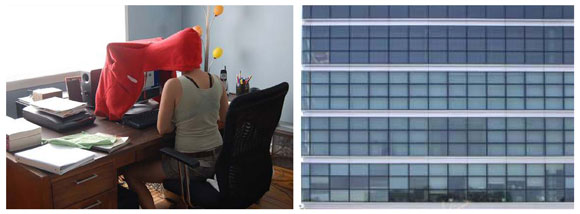
Design Problem: extensive glass facades, a popular architectural feature, create a very problematic visual conditions due to glare (left) or façade covered by curtains, with no use of daylight but merely artificial lights (right).

The use of large glass facades, currently a popular architectural feature, does not ensure better use of daylight, as is often suggested, and in fact may create glare hazards. As a result, we often see windows that are permanently covered by closed blinds or opaque curtains, with electric lights switched on even during the daytime.
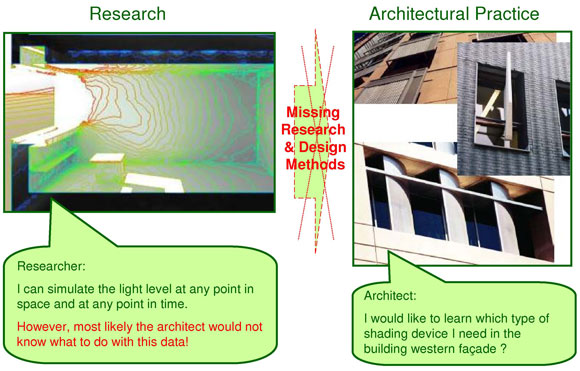

Methodological Problem: research in architectural practice encounters difficulties since most daylighting research methodologies and tools designed for academia. However, the academic research process is fundamentally different from processes in architectural practice.

Methodological Problem: research in architectural practice encounters difficulties since most daylighting research methodologies and tools designed for academia. However, the academic research process is fundamentally different from processes in architectural practice.

The research consists of two parts: first, a study of daylighting in offices in sunny locations, which was used to draw mainly prescriptive and performance recommendations, as well as to serve as a case study for a research process. From the architect’s point of view, both performance and prescriptive recommendations are somewhat limited, since they do not teach how to design optimized or unique solutions. Therefore, in addition, the second part of this research consists of the development of methodological recommendations for the integration of daylighting research during the architectural design process.


Glare Analysis Methodology: measurements and analysis of glare were carried out by using High Dynamic Range Photography (Left) to generate Luminance Map (Right).

Glare Analysis Methodology: measurements and analysis of glare were carried out by using High Dynamic Range Photography (Left) to generate Luminance Map (Right).

The first part of the research included a field survey of offices and a controlled experiment on daylighting. The field survey was carried out to identify some of the causes for extensive use of artificial lights in Israeli offices, where substantial energy saving may be achieved through the use of daylight; and to examine various survey techniques.
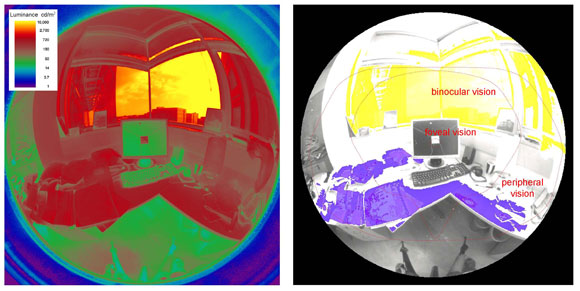

Field Survey of Offices : luminance map (left) and glare analysis (right) of case study # 015.   The office suffers from problematic visual conditions: when blinds open, glare negatively affect the working environment quality; and when they are closed, the natural illuminance is low, requiring artificial lights. As a side effect, desirable view outside will often be blocked by shading systems due to glare.

Field Survey of Offices: luminance map (left) and glare analysis (right) of case study # 015.
The office suffers from problematic visual conditions: when blinds open, glare negatively affect the working environment quality; and when they are closed, the natural illuminance is low, requiring artificial lights. As a side effect, desirable view outside will often be blocked by shading systems due to glare.

The survey confirmed that offices often suffer from problematic visual conditions: When blinds or curtains are open, glare may affect the quality of the working environment negatively; and when they are closed, the result is often low natural illuminance, forcing the occupants to use artificial lights.
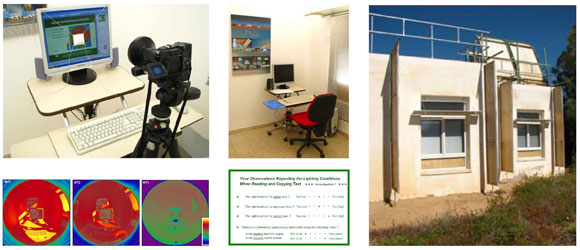

A Controlled Experiment on Daylighting: a statistical survey of visual comfort in a controlled office environment; including objective measurements (left) and subjective responses to a questionnaire (middle), carried out simultaneously in two identical rooms (right).

A Controlled Experiment on Daylighting: a statistical survey of visual comfort in a controlled office environment; including objective measurements (left) and subjective responses to a questionnaire (middle), carried out simultaneously in two identical rooms (right).

The controlled experiment was carried out to evaluate the effectiveness of several daylighting systems and office layouts with regard to visual comfort and energy conservation in sunny regions, and to evaluate the predictive power of several glare indices. The survey, which included 59 subjects, was carried out in a daylit environment set up to simulate a typical office. Visual comfort was evaluated based on both objective measurements and subjective responses to a questionnaire.


Selected Results -- A light shelf: A light shelf located between upper daylight windows and lower view windows, with blinds closed when low solar, was found as good means for providing sufficient natural illuminance without glare.

Selected Results — A light shelf: A light shelf located between upper daylight windows and lower view windows, with blinds closed when low solar, was found as good means for providing sufficient natural illuminance without glare.

Overall, the experiment showed that the effect of tinted glazing and desk position on visual comfort was quite modest. The effect of blinds on visual comfort was positive (although blinds require frequent adjustment, which is rarely done in practice). A light shelf with blinds deployed below it may provide high quality daylight: it reduces glare in a working area near the window while enabling higher illuminance levels deeper in the office. Subjects were happy with relatively high levels of horizontal illuminance at their desk, well above the minimum recommended in ISO Standard 8995 for the illumination of work spaces.
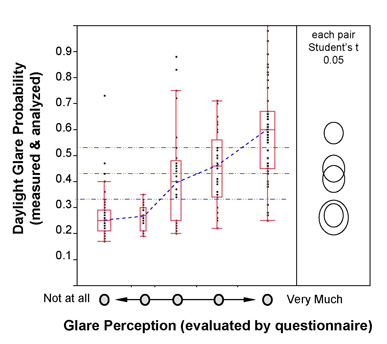

Selected Results -- Validation of Glare Indices for Sunny Regions: A clear relationship identified between measurements and the subjects’ assessment of glare, enables safer use of these indices for daylighting design and research in sunny regions.

Selected Results — Validation of Glare Indices for Sunny Regions: A clear relationship identified between measurements and the subjects’ assessment of glare, enables safer use of these indices for daylighting design and research in sunny regions.

While the glare indices DGI, UGR, CGI, and VCP may differentiate between glare and non-glare conditions, they are less effective in distinguishing between various levels of glare in brightly lit offices. In contrast, the Daylight Glare Probability (DGP) index, which was designed specifically for daylit environments (but which is based on a survey conducted in Germany and Denmark, countries with relatively overcast skies, and while using Venetian blinds most of the time) was shown to be effective in Israel, too.
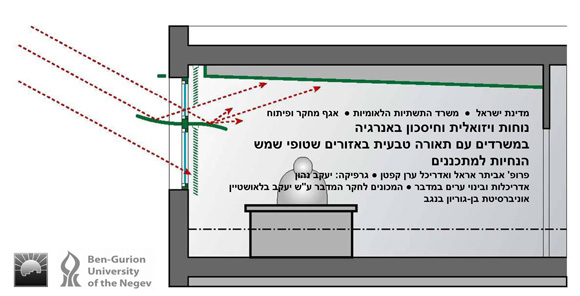

A Fundamental Daylight Solutions: a part of recommendations (in Hebrew) for better design of daylighting in sunny regions, available at  http://www.bgu.ac.il/CDAUP/daylighting-guidelines-hebrew.pdf (Prof. Evyatar Erell & Dr. Eran Kaftan. 2011. The Israeli Ministry of National Infrastructures. 50p.).

A Fundamental Daylight Solutions: a part of recommendations (in Hebrew) for better design of daylighting in sunny regions, available at http://www.bgu.ac.il/CDAUP/daylighting-guidelines-hebrew.pdf (Prof. Evyatar Erell & Dr. Eran Kaftan. 2011. The Israeli Ministry of National Infrastructures. 50p.).

Finally, conclusions from both investigations were used to generate local recommendations: guidelines for architects, submitted to the Israeli Ministry of National Infrastructures; and a proposal for a revision of the daylight section of the Israel Green Building Standard (Standard 5281).


Relevant Publications

Kaftan, Eran. 2012. Daylighting for Visual Comfort and Energy Conservation in Offices and the Development of Methodologies for Research in Architectural Practice. A Ph.D. Dissertation. Ben-GurionUniversity of the Negev, Israel.

Erell Evyatar, & Kaftan, Eran. 2011. Daylighting for Visual Comfort and Energy Conservation in Offices in Sunny Locations. A Research Report. Ministry of National Infrastructures, Israel.

Erell Evyatar, & Kaftan, Eran. 2011. Daylighting for Visual Comfort and Energy Conservation in Offices in Sunny Locations: Guidelines for Designers. Ministry of National Infrastructures, Israel.

Project of the Year 2012, in Research Category: the Emilio Ambasz Award for Green Architecture. “Positioning Workstations in Sunny Areas”. Published in Architecture of Israel (Architectural Quarterly). No. 91, pp 65 & 68. 2012.

Erell, Evyatar & Kaftan, Eran & Garb, Yaakov. (2014). Daylighting for Visual Comfort and Energy Conservation in Offices in Sunny Regions. Conference: 30th PLEA International Conference – Sustainable Habitat for Developing SocietiesAt: Ahmedabad, India.

Kaftan, Eran, 2015. The Science & Art of Daylighting Design. Electricity & People: periodical of  the Society of Electrical and Electronics Engineers in Israel. No. 56. P 50.

Wienold, J., Iwata, T., Sarey Khanie, M., Erell, E., Kaftan, E., Rodriguez, R., … Andersen, M. (2019). Cross-validation and robustness of daylight glare metrics. Lighting Research & Technology, 51(7), 983–1013. The paper received the Leon Gaster Award from the Society of Light and Lighting (CISBE).

Geraldine Quek, Jan Wienold, Mandana Sarey Khanie, Evyatar Erell, Eran Kaftan, Athanasios Tzempelikos, Iason Konstantzos, Jens Christoffersen, Tilmann Kuhn, Marilyne Andersen. 2021. Comparing performance of discomfort glare metrics in high and low adaptation levels. Building and Environment, Volume 206, 2021.


Optimal Shading

 Optimal-Shading_M


The Cellular Method for Optimal Shading

Master Thesis. Author: Eran Kaftan
Committee Members: Chalfoun N. (chair), Yoklic M., Matter F., Medlin L., & Sobin H.
The University of Arizona, College of Architecture, 2001.

Abstract

The cellular method is an innovative approach to design an optimal shading. The method offers calculating an optimal shading form, accounting for both needs of summer solar protection and winter solar gain. As a result, it provides better thermal comfort and maximum annual energy conservation in cooling and heating. The method can generate Mapping of Shading Importance for any location in the world, any opening configurations, and any preferred period (such as year, season, month, etc.). The mapping indicates, for these particular settings, the optimal form of shading-means (such as shading device, overhang, etc.). Since architectural and environmental settings are varied, the calculated optimal shading forms usually have unique forms, often complex and intriguing. Such forms are not only enriching the building façade, but also correspond best to the specific environmental conditions.

The method was developed by architect Dr. Eran Kaftan, in the framework of a M.Arch thesis at the University of Arizona (2001). It was presented at several international conferences and at leading international architectural and engineering offices, such as Frank Gehry & Associates; ARUP; and Foster and Partners. In addition, it was integrated in several simulation programs, Autodesk Ecotect and SHADERADE of Harvard University.

Optimal-Shaing_N

Optimal Shading

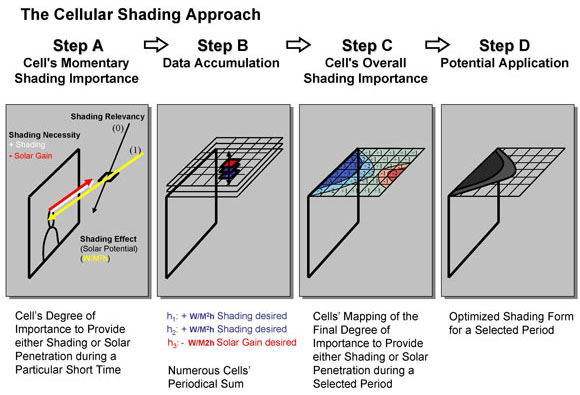
The design of shading-means which provides optimal shading (establishing maximum reduction in the building energy consumption) is rather complex, requiring solving the fundamental “Shading Dilemma”. On the one hand, shading intercepts summer direct solar radiation, thus, reducing the cooling loads during the summer (positive effect); however, on the other hand, shading also reduces desirable winter solar gain and daylight, thus, increasing the heating and artificial lighting loads (negative effect). Therefore, an optimal form of a shading device or overhang should provide an optimal balance among the necessity for solar obstruction, solar gain, and daylight. Since solar radiation varies according to different sun angles, and the sun appears in the sky in curved pathways, even a rectangular window will not have a simple optimal shading form. In addition, since windows or walls are varied in configurations, orientations, and locations around the world, it is natural, that each one requires a unique shading form. An optimal shading form can help in optimizing annual building energy conservation, reducing the cost in operating mechanical systems of cooling and heating; thus supporting the world energy conservation and sustainability.

The Cellular Method

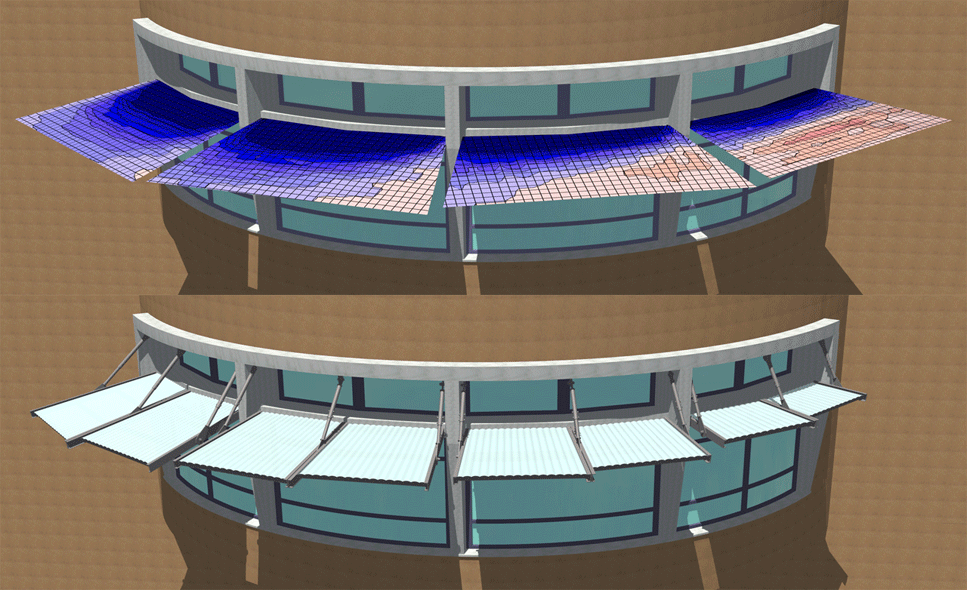
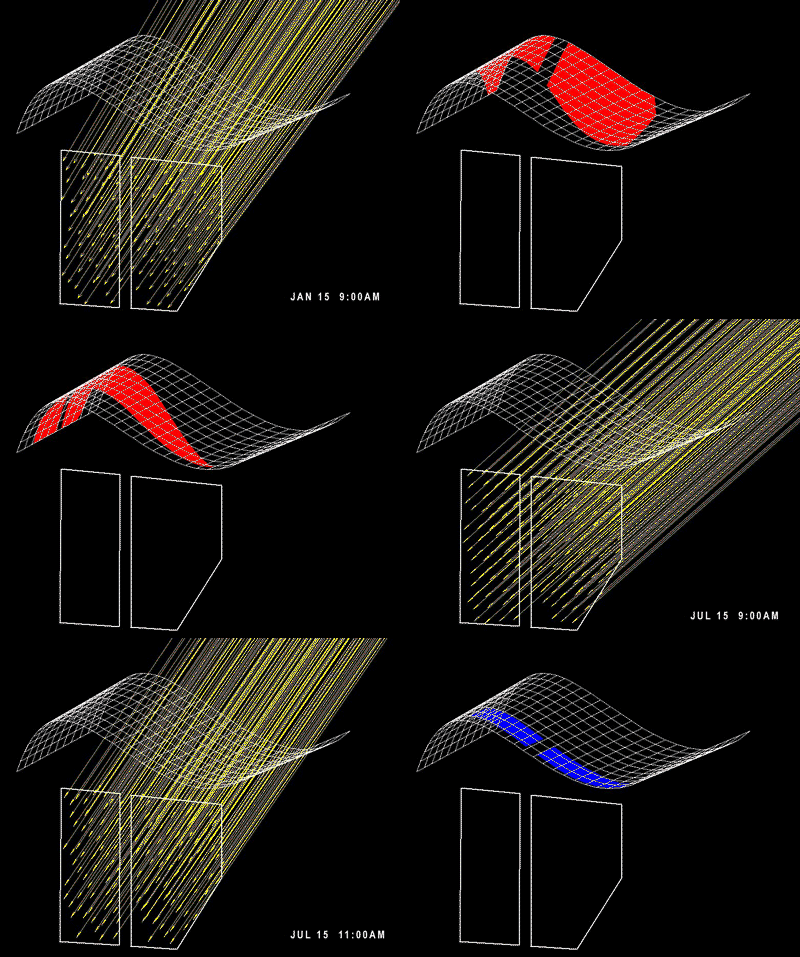
The Cellular Method for Optimal Shading evaluates numerous theoretical-cells of proposed shading-means (such as shading device, overhang, etc.) for their degree of importance to provide shade or solar penetration. Then, this information can be utilized to modify the proposed shading-means. The method can also be used to determine new shading-means, by evaluating numerous theoretical-cells of space adjacent to a proposed shaded space (such as window, courtyard, etc.). Calculations of the optimal shading form takes into consideration the window configuration, orientation, and geographical location, as well as hourly solar radiation and hourly thermal comfort conditions at the space needed to be shaded. This process can be applied to a particular preferred period, in order to design fixed or seasonal shading-means (such as shading devices, overhangs, shading membranes, etc). In addition, it can be applied to a sequence of short time-segments, in order to design dynamic shading systems.

OS_Cellular-Shading-Approch


Nizana_Optimal-Shading_967

Applications

[reduced width] The Cellular Method for Optimal Shading was implemented in several state-of-the-art simulation programs. [/reduced width]

RecoD_Optimal-Shading-Tool

Excel Tool (2001)

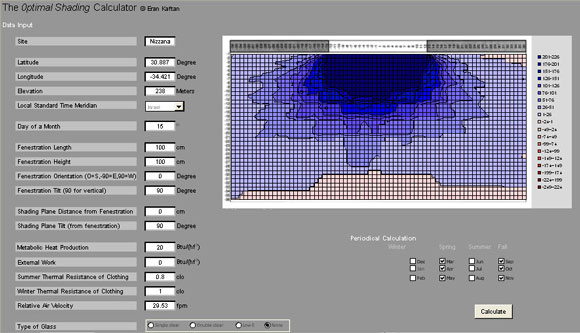
An excel tool, OPTIMAL-SHADING, uses the Cellular Method for Optimal Shading, through about 800,000 calculations, to determine the optimal shape of shading-means. The tool is limited to simple forms of windows, and requires an external thermal analysis.


Ecotect’s Cellular Method Plugin (2005)

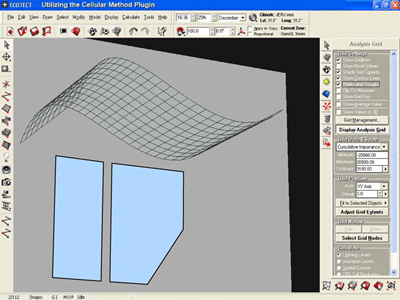
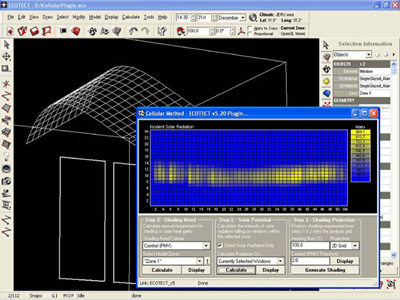
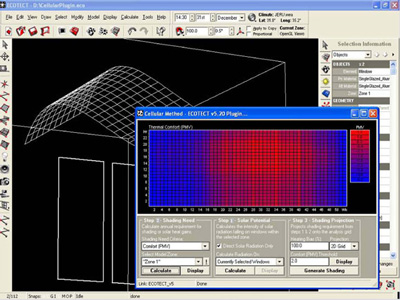
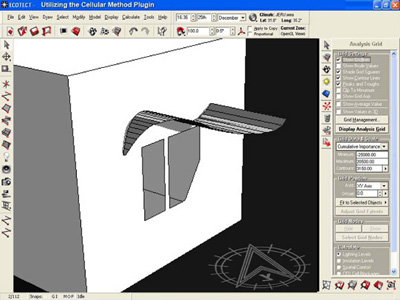
Collaboration between Research & EcoDesign and Ecotect developer (SQUARE ONE research) has produced an external Plug-In for Ecotect software. The plug-in uses the Cellular Method for Optimal Shading to determine for outdoor locations the degree of importance to provide either shading or solar penetration during a period. The process is carried out in the following steps:

1. Setting a shading grid;

1. Setting a shading grid;

2.Calculating annual solar potential (solar radiation admitted or eliminated through selected windows);

2. Calculating annual solar potential (solar radiation admitted or eliminated through selected windows);

3. Calculating annual shading needs (the requirements for either shading or solar gain, according to thermal comfort,  zone temperatures, or  heat gain and losses);

3. Calculating annual shading needs (the requirements for either shading or solar gain, according to thermal comfort, zone temperatures, or heat gain and losses);

4. Conducting hourly shading projection and a data accumulation process (at all cells);

4. Conducting hourly shading projection and a data accumulation process (at all cells);

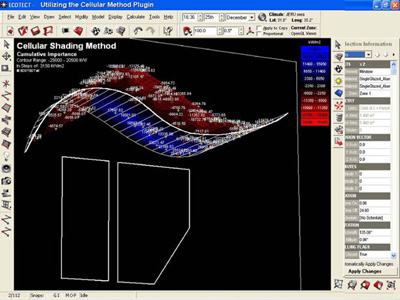
5. Reciving a map of final degrees of importance at different regions of a proposed shading; device, to provide either solar shading (blue scale) or solar penetration (red scale) during a period (such as the entire year);

5. Reciving a map of final degrees of importance at different regions of a proposed shading; device, to provide either solar shading (blue scale) or solar penetration (red scale) during a period (such as the entire year);

6. Optimizing the shading form acording to the shading importance map.

6. Optimizing the shading form acording to the shading importance map.

Ecotect-Shading-PotentialAutodesk Ecotect (2008)

Another result of the collaboration with Ecotect developer is that major parts of the Cellular Method for Optimal Shading can be used directly within the Autodesk Ecotect software. The tool can be launched through a “shading potential” calculation option. The tool calculates the relevant accumulation of radiation data on an analysis grid for a selected period, but in contrast to the plug-in, it does do not account for both summer needs for shading and winter needs for solar penetration. Additional information may be found in Ecotect’s help files.


Harvard-SHADERADESHADERADE (Harvard University; 2011)
The tool uses a modified version of the Cellular Method for Optimal Shading to generate optimal shading using Rhinoceros® and EnergyPlus programs (it is scheduled to be released as an addition to the DIVA-for-Rhino plug-in).


Relevant Publications

Kaftan, Eran. (2001). The Cellular Method to Design Energy Efficient Shading Form to Accommodate the Dynamic Characteristics of Climate. Master Thesis (Architecture). The University of Arizona. 183p.

Kaftan, E. (2001). The Cellular Method to Design Energy Efficient Shading Form to Accommodate the Dynamic Characteristics of Climate. Conference proceedings. PLEA 2001 – The 18th Conference on Passive and Low Energy Architecture. Florianopolis, Brazil. Volume 2. pp 829-833.

Kaftan, E. (2002). Cellular Method for Optimal Solar Shading. US Patent Application. 46p.

Kaftan E. & Marsh A. (2005). Integrating the Cellular Method for Shading Design with a Thermal Simulation. The International Conference on Passive and Low Energy Cooling for the Build Environment (PALENC 2005), Santorini, Greece.

Kaftan, E. and Ben-Aharon R. (2005). Passive – Yet Not Indifferent: Cellular Shading Method. Architecture of Israel (Architectural Quarterly). No. 62, pp 51-55.

Sargent, Jon, Niemasz Jeffrey, & ReinhartChristophF. (2011). SHADERADE: combining rhinoceros and energyplus for the design of static exterior shading devices. Building Simulation 2011. Sydney, Australia.

Kaftan Eran, 2015. Urban Shade: Thermal and Visual Experience. Urban Shading In Israel. Editor: Martin Weyl. Israel.

Canyon-Space Residence

Canyon-Space_M


Canyon-Space Residence

A Living Space Embedded within the Natural Environment – Arizona’s Desert – 2001.
Architect: Eran Kaftan, RecoD.
Won in September 2004 the First Prize of the Young Architects Exhibition, the Israeli Architects Association.


Interior Space

Interior Space


Drawings

D-CS_Sections


D-CS_Floor-Plan


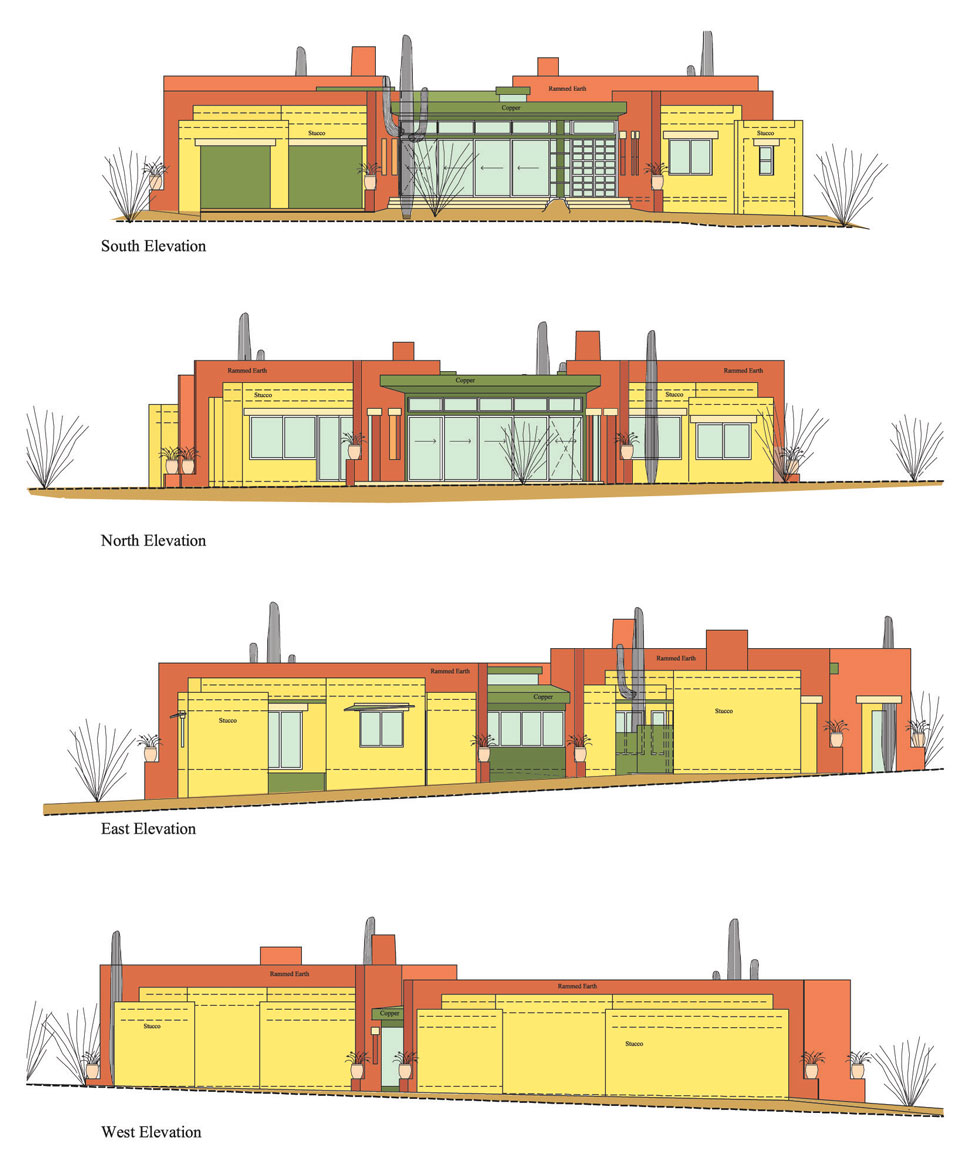
D-CS_Elevation

Design Concepts

General Composition

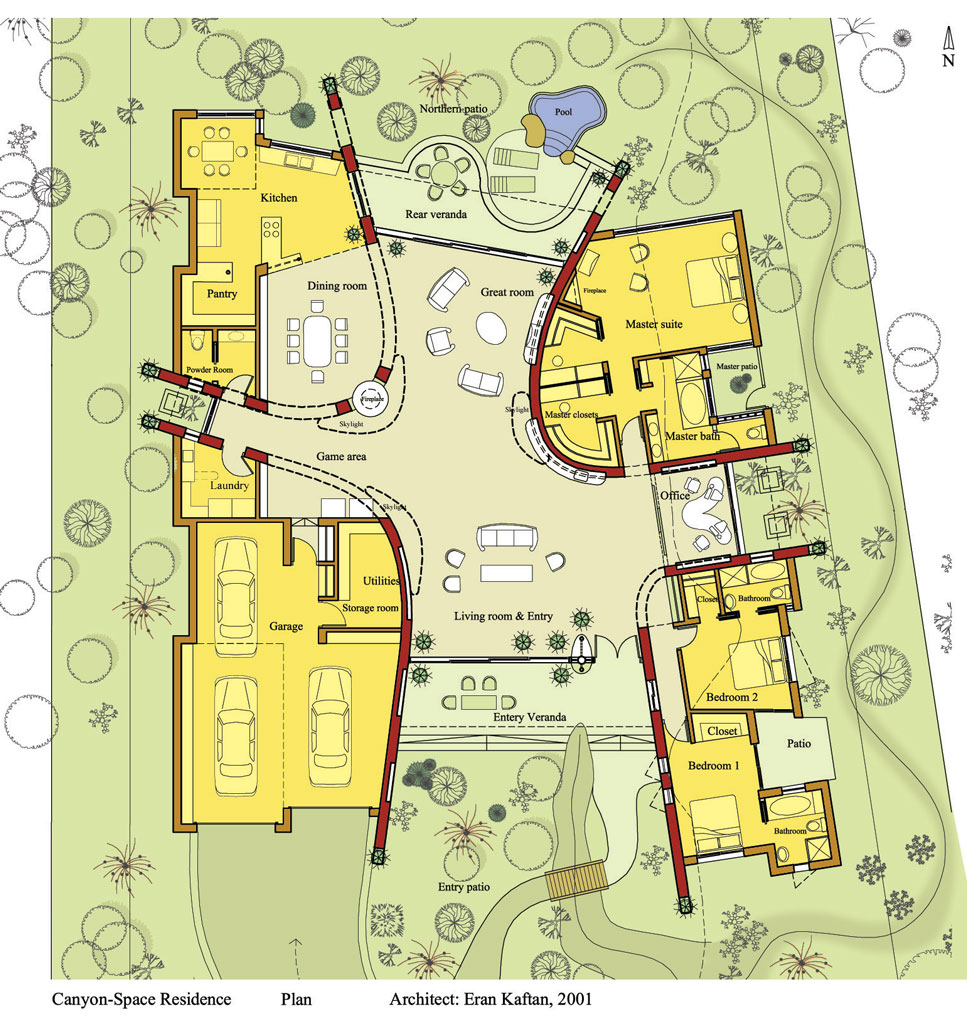
The building masses were arranged in four clusters, divided by major openings. One can draw a parallel with the composition of the surrounding mountains with the canyons within them. This composition also enables employing a unique and modern curved interior with an exterior appearance which complies with particular enclave guidelines of Santa Fee style. The building core, bounded by convex curved walls and major openings, accommodates the semi-public areas, the living room and the family room. Other functions are enclosed within interior concave walls and exterior walls.

Visual habitat

The major openings were designed to connect the building core with the surrounding scenery and the immediate natural landscape. Prime openings to the North and South include extensive movable glass screens to accommodate the extraordinary scenery of mountains in the north and city in the South. To the north, the central roof is inclined upward to accommodate the mountain view and a larger portion of the day and night sky. Several skylights, further connect the residents to the day and night sky. Secondary openings to the East and the West provide additional relief to the enclosed interior space. The roof in these orientations is inclined downward for drainage. All openings enclose patios, which employ the natural flora as a desert garden. Those were situated to accommodate existing precious saguaro cacti and flora.

Natural Illumination

The northern and southern openings provide prime natural illumination. The southern openings provide the warm and bright direct and reflected daylight; and northern openings provide the cool and diffused daylight. The eastern and western openings enable the warm daylight of sunrise and sunset to penetrate into the building core; extending the natural illumination period, expanding the entered natural spectrum, and celebrating the dynamic changes of nature through time. The bedrooms and the kitchen benefit from morning natural illumination and thermal heating.

Natural Energy Flow

A large curved space which connects the prime northern and southern openings enables a natural energy flow (Chi) from the nearby northern canyon through the building core to the South. The meandering shape of this space contributes for better distribution of the energy throughout the building and relief the governing symmetry. Natural drainage was relocated to the East to eliminate uncontrolled natural energy  under the building, leaving the building as a safe island. A curved line of glass blocks is embedded in the central floor to mark the historical stream.

Natural Inhabitant Circulation

The curved walls in the building core enable a natural path with least resistance for better inhabitant circulation, keeping the occupants velocity of movement somewhat constant.

Thermal Barrier & Solar Shading

The western sections of the building consist of mainly service areas with only a small opening to the northeast. These spaces operate as a thermal buffer zone protecting from the harsh west solar orientation and also protect the view into the house from neighbor residences. Most exterior walls were designed to incorporate either compressed straw blocks or recycled polyester, providing good insulation from the hot summer days and cold winter nights. Openings to the South and to the East are covered by shaded patios, overhangs, or shading devices to eliminate late-morning and noon summer solar penetration.

Passive Solar Heating & Thermal Storage

A major southern opening and a seasonal overhang opening enable winter solar penetration into the building core, heating the indoor air. In addition, the radiation is stored in the thermal mass of the interior Rammed-Earth curved walls and exposed concrete floor. The thermal mass is employed in winter to store direct solar radiation in the daytime to be released to the space at night.

Natural Ventilation & Thermal Storage

In the summer days, the interior thermal mass is employed to absorb the heat from the space, reducing the indoor air temperatures. Then, during the night the stored heat is removed by natural cross ventilation. The north-south natural cross ventilation is enhanced by night cold drafts sinking down the canyon; and by afternoon rising air from the Tucson valley. Both natural air-flows create pressure and wake zones at the major openings, driving significant natural ventilation through the building core. This prime air-flow drives airflow through the other rooms through suction.

Sustainable Materials

The chosen building materials of compressed straw blocks, recycled polyester, and Rammed-Earth are sustainable alternative natural materials which do not include much embedded energy. In addition, those will ultimately be recycled to soil.

Skylights

Partially protected skylights separate the central roof from the curved walls creating the perception of a floating roof; and enabling daylight deeper into the building core. One skylight accommodates a fireplace, providing a source of warmth at the center of the building. The other accommodates a glassed rain collector to further enrich the living space with the dynamics of nature.

Site & Early Design

Northern View of the Mountains and Canyon

Northern View of the Mountains and Canyon


Western View at Sunset

Western View at Sunset


Southern Twilight View of Tucson Valley

Southern Twilight View of Tucson Valley


Site & Natural Flora

Site & Natural Flora


Site Compass of Views and Sun Path

Site Compass of Views and Sun Path


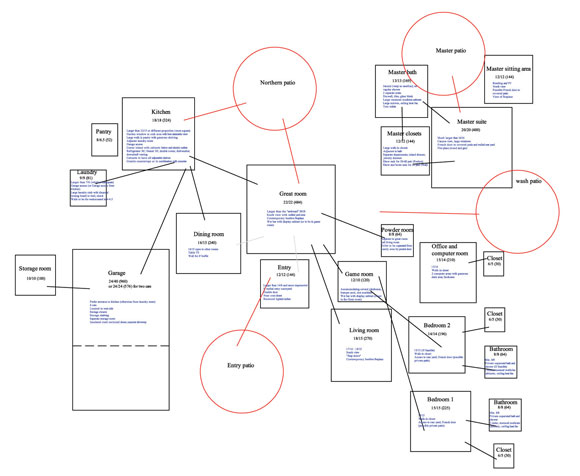
Architectural Programming

Architectural Programming


Early Design Concepts: Site Integration and Shape

Early Design Concepts: Site Integration and Shape

Climatic Modeling


Annual Sun Path Modeling of Tucson, Arizona

Annual Sun Path Modeling of Tucson, Arizona


Winter Average Daily Solar Gain

Winter Average Daily Solar Gain


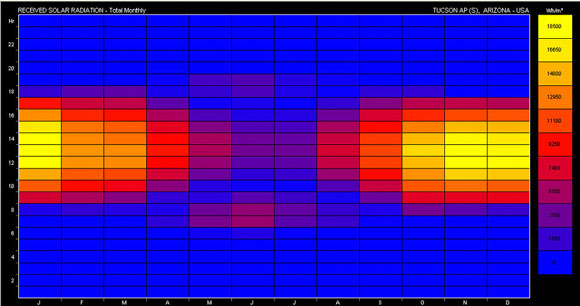
Annual Received Solar Radiation

Annual Received Solar Radiation


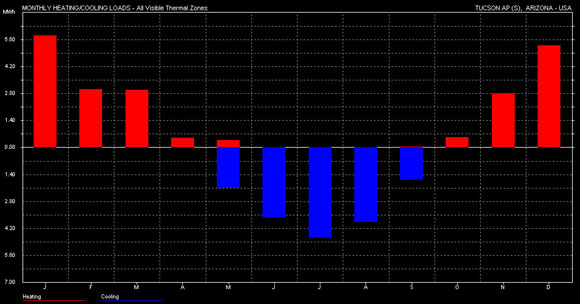
Monthly Heating and Cooling Loads

Monthly Heating and Cooling Loads

Daylight Simulation

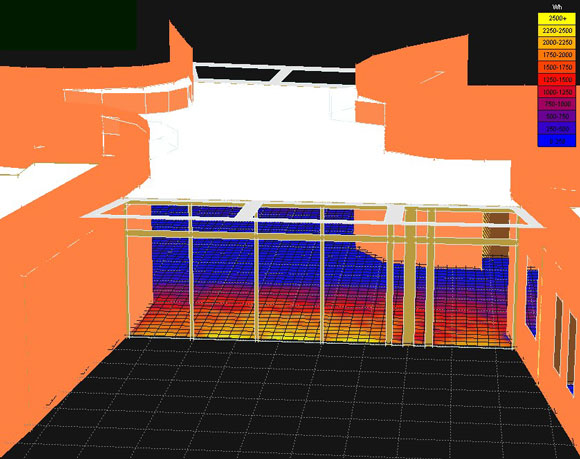
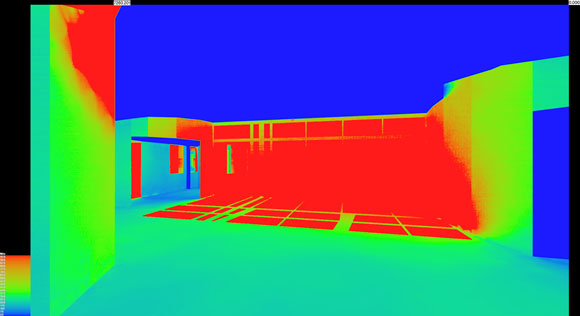
Summer Noon illuminance Iso-Level at June 21th, 12:00am

Summer Noon illuminance Iso-Level at June 21th, 12:00am


Winter Noon Luminance Iso-Level at December 21th, 12:00am

Winter Noon Luminance Iso-Level at December 21th, 12:00am


Spring Sunrise Luminance Level at March 21th, 7:15am

Spring Sunrise Luminance Level at March 21th, 7:15am

Relevant Publications

First Place, Young Architects Exhibition, the Israeli Architects Association, “Canyon-Space Residence” 2004.

Kaftan, Eran. 2005. Canyon-Space Residence: Living Space Embedded within the Natural Environment. Perspective (the Israeli Architects Association Periodical). No. 21, p 48.

Third Biennale for Young Israeli Architects (40/40), “Canyon-Space Residence: Living Space Embedded within the Natural Environment”, 2005.

  • A A A
info@RecoD.net © Dr. Eran Kaftan RecoD